
We realize that what we accomplish is only a drop in the ocean. But if that drop did not exist, it would be missing.
Mother Teresa
Eolyss is partner of Green Marine.
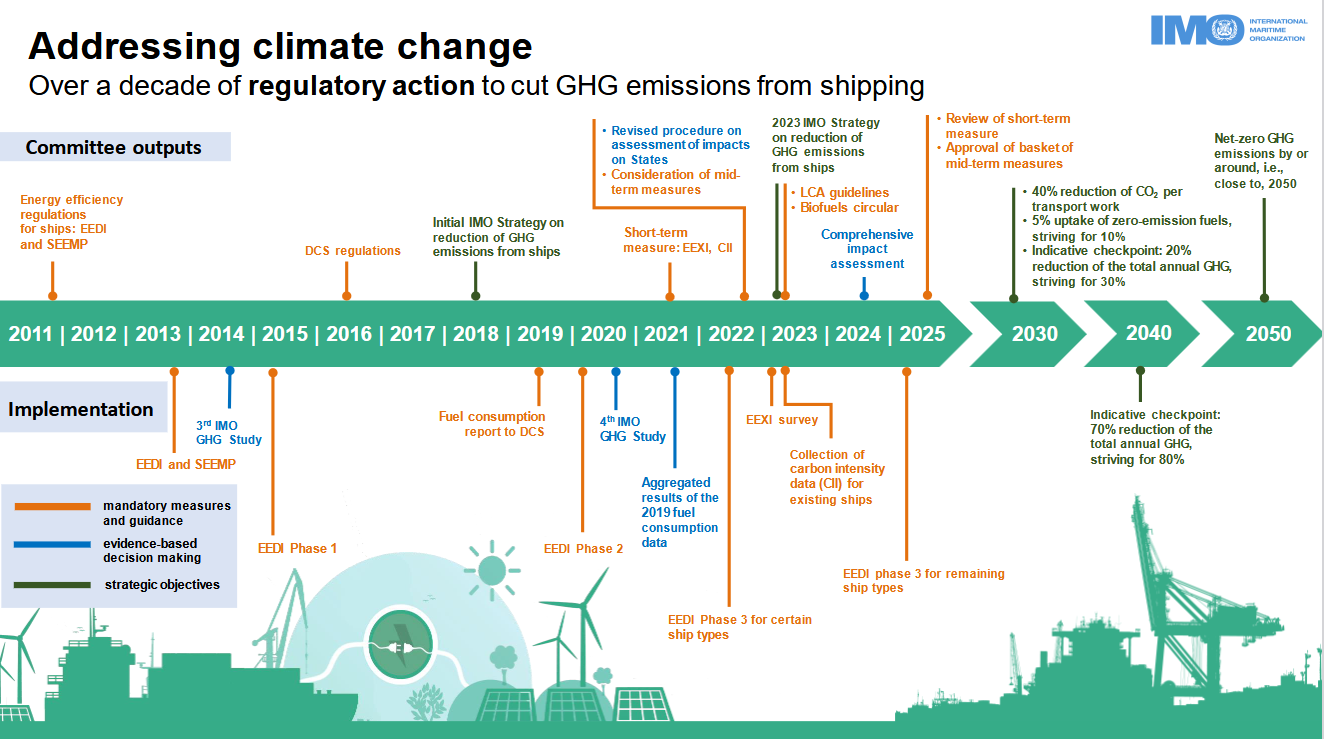 OMI decarbonation roadmap
| Date | Title | Target | Description |
|---|---|---|---|
| 2027-01-01 | Green Balance Mechanism | Ships > 5000 GT | The IMO and the World Shipping Council (WSC) aim to make shipping carbon neutral by 2050. This highly ambitious objective requires to shake up the current fuel market and promote the supply of alternative fuels (biofuels, e-fuels, ammonia, hydrogen, etc.). The current situation shows that alternative fuels are 3 to 4 times more expensive than their fossil equivalent, and that the current supply can in no way replace fossil fuels. To reverse this trend, the IMO and the WSC have set up a financial mechanism to reduce the price differential between alternative and fossil fuels, and to encourage producers to increase the supply of alternative fuels. This mechanism, the Green Balance Mechanism, promises to add a levy on ships with low carbon performance to fund vessels moving in the more expensive direction of alternative fuels, and also to incentivize producers to invest in this in-demand sector. Source : MEPC 82 |
| 2024-07-01 | HFO in arctic | Any ship | As of July 1, 2024, HFO fuels will be banned from shipping in Arctic waters. Source : MEPC 76 |
| 2023-01-01 | CII rating | Ships > 5000 GT | From January 1, 2023, all commercial vessels over 5000 t gross tonnage must report their CII (Carbon Intensity Indicator). This indicator, by comparison with other similar ships, will determine a grade from A (best) to E (worst) that will indicate the value of the ship according to its carbon emission potential. These scores position the vessel on a GHG emissions percentile scale:
Ships with an E rating must submit a GHG emissions reduction plan within one year. D ships have 3 years to submit this reduction plan. A and B ships could be favored at ports and served more quickly. Each year, the criteria for achieving the grade will be tightened. Source : MEPC 76 |
| 2023-01-01 | EEXI | Ships > 400 GT | As of January 1, 2023, all commercial vessels over 400 t gross tonnage must report their EEXI (Energy Efficiency Existing ship index). This indicator reports the GHG emission capacity per t transported over a distance of 1 NM. When a ship is built, the EEDI index must be attached to the ship and characterizes its GHG emission capacity. Older ships that have not been provided with the calculation of this index, must have a similar index calculated, the EEXI. Similarly, a vessel already provided with this index but having undergone modifications must again have the new EEXI index associated Définitions:
|
| 2020-01-01 | ECA Sulfur | All ships | From 1 January 2020 the global upper limit on the sulphur content of ships' fuel oil will be reduced to 0.50% (from 3.50%). Known as "IMO 2020", the reduced limit is mandatory for all ships operating outside certain designated Emission Control Areas*, where the limit is already 0.10%. Source : IMO 2020 |
| 2018-12-31 | SEEMP part I | Ships > 400 GT | SEEMP part I requires a ship to provide an energy efficiency plan management. |
| 2018-12-31 | SEEMP part II | Ships > 5000 GT | SEEMP part II requires a ship to provide its annual fuel consumption. IMO uses the DCS protocol to allow data transmission. |
Note : This summary focuses on the constraints related to the decarbonization of the merchant navy, but it does not pretend to present all the decrees to which the ships are subjected and cannot replace the official organizations on this plan.

Eolyss / copyright 2019 - 2025
Eolyss Solutions inc - Canada / Quebec 1175195081
136, avenue Vivian Montreal H3P 1N7 Qc Canada