
There are no passengers on the ship Earth. We are all members of the crew.
Marshall McLuhan
Eolyss is partner of Green Marine.
SOLUTION
EOLYSS

Eolyss objective is to support the environmental compliance efforts of the maritime sector (carriers, charterers, freight forwarders, shippers, ports and others), particularly with regard to the reduction of pollutant emissions (GHG, NOx, SOx and PM10). Eolyss offers the following solutions:
GHG avoidances are calculated in relation to a means of transport using the reference ship as proposed by the IMO.
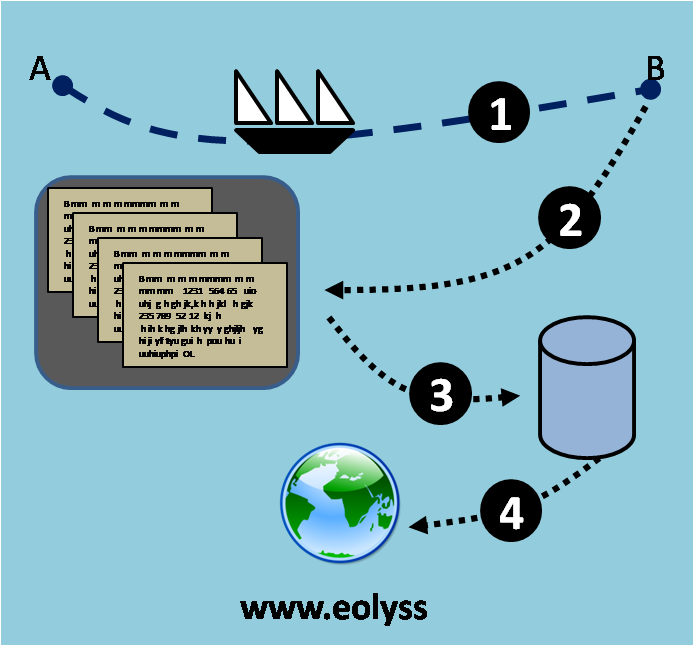
 A vessel is going from Port A to Port B.
 The ship sends the bill of lading (the BOL) to Eolyss.
 Eolyss feeds the database with this information and calculates the GHG avoidances and fuel savings.
 Avoidances and savings generated by the ship instantly becomes available.
It is then possible to compare the performances of a reference transport with those of the current one (the eco-responsible transport) and to determine its environmental efficiency.
By principle, the ship under study is called Eco-Responsible Transport (ECO) and the typical comparison ship is called reference Transport (REF). The normal work process is to compare an optimised ship (e.g. a sailing ship) with the equivalent traditional means that would have been used if the optimized ship was not available. In many situations, therefore, when calibrating a traditional vessel (or a fleet of traditional vessels), the current vessel will be compared with its reference equivalent vessel. The former will qualify as ECO while the latter will qualify as REF, even though both are traditional vessels.
Single-segment routes correspond to the basic situation where the analyzed route consists only of the maritime segment. These routes can be used to compare a reference transport with eco-responsible transportation in the case of maritime transporter, but they are not very representative of reality in the case of a shiper. Indeed, a shipper will most often add one or more pre-shipment stages before shipping, and will also have to rely on one or more post-shipment stages for the goods to arrive safely.
Multi-segment routes are used to quantify the transport of a point-to-point load. They make it possible to evaluate the avoidance for a product including terrestrial segments of any nature (road, rail, fluvial, air ...), and are thus of great interest for the shippers (for example, transporting a machine-tool from city X to A, as illustrated below).
Above stages 1 to 4 are the same, but step 1 breaks down into more individual segments (pre or post shipment).
The following example illustrates this principle.
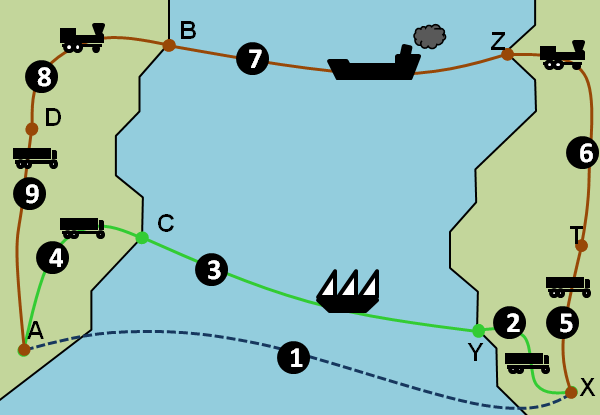
[Pre] characterizes a segment in pre-routing.
[Post] characterizes a segment in post-routing.
- Multi segment route: Transportation from the city X to the city A. - [Pre] The load is transported by truck from X to port Y. - The cargo is transported by eco-responsible ship from port Y to port C. - [Post] Loading is trucked from port C to destination A. - [Pre] The load is transported by truck from X to a multimodal train / road node T.
 - [Pre] The load is transported by rail from T to port of shipment Z.
 - The load is transported by a reference vessel on the Z - B sea route.
 - [Post] Loading is transported by rail from B to intermodal node D.
 - [Post] The load is transported by truck from D to its final destination A.
In this example, the analysis is not just about comparisons of the environmental performance of ships (3 and 7), but across the supply chain. The comparison is between the emissions of segments 2, 3 and 4 and those of segments 5, 6, 7, 8 and 9.
This example illustrates the flexibility that an eco-responsible vessel can bring. In reality, the reference transport is typically provided by a large container ship (CS) carrying 10,000 containers or more. These vessels, because of economies of scale and their recent construction, generally offer good emission factors (GHG, NOx, SOx) per t.km transported. On the other hand, their imposing size limits the ports of reception to the very large ports, which reduces the available routes by the same amount and imposes a heavier logistics to dispatch the goods to and from these ports, hence more constraints in the pre and post-routing.
In contrast, a much smaller eco-responsible vessel can dock at many secondary ports and can reduce pre and post-routing, requiring fewer steps on the overall route, and therefore fewer emissions. It is paradoxically possible that the avoidances between the eco-responsible ship and a container-ship are weak, or even, in some cases, to the advantage of the container-ship, but that the gains on the other segments alone justify the choice of the eco-responsible ship (road transport has very bad emission factors compared to ships). Logistically speaking, the fewer segments, the more efficient the transport is.
Eolyss makes visible the actors (carriers and shippers) who decide to promote a virtuous and responsible transport. These companies can use this information according to their communication plan.
Several approaches make it possible to reduce marine pollution in sometimes extremely important proportions (avoidances higher than 90% are credible objectives):
Sails The wind propelled the ships for millennia until the beginning of the 20th century where it was quickly supplanted by fossil energy (oil, coal, gas ...) because of the greater operationality offered by the machines. Free non-polluting energy did not withstand the many benefits of fossil energy, despite the costs involved.
Today, environmental considerations, the scarcity of fossil fuels and the search for viable alternatives that are less polluting have led to a reconsideration of the old sailing tradition of commercial transport.
New technologies, navigational aids and the potential for wind energy offer an effective alternative to traditional transportation while providing a relevant response to pollution created by the marine industry.
Kites The use of giant kites under specific wind conditions can lead to significant reductions in fuel consumption.
Speed Reducing the speed of vessels can be an alternative to reduce fuel consumption. This reduction is obviously at the expense of increased journey time.
Fuels The fuels used to propel ships are very unrefined and have very high sulfur levels. Cleaner fuels can be used at the expense of higher purchase cost. Regulations also encourage carriers to use fuels that are less harmful to the environment.
Since January 1st 2020, the IMO (International Maritime Organization) has required the use of less sulphurous fuels for all merchant ships, decreasing the sulphur content from 3.5% to 0.5%.
Size The gigantism of ships is a way to reduce marine pollution by reducing the use of fuel per tonne transported. However, this trend is to the detriment of the diversity and choice of maritime routes where only high-traffic links are offered.
Alternative energies Will tomorrow ships be equipped with hydrogen fuel cells, be electric-powered, be solar-powered?
Logistics Logistics can be improved by optimizing maritime resources and favoring less polluting freighters.
Technical improvements As in any industry, technical improvements can significantly reduce emissions from traditional ships. New shipping practices can also contribute to these reductions, for example by better tuning cruising speed. Some shipowners are also taking interesting measures by lightening containers, using non-exotic woods, using paints that are less loaded with solvents...
Biofuels The use of biofuels shows great potential, but is a bit confusing. Whether a fuel is of fossil origin or derived from the transformation of biomass, it will emit the same quantities of GHGs. On the other hand, its life cycle analysis, by deducting the GHGs captured during biomass growth, leads to a much lower balance sheet than if it were from fossil sources. This avenue is being explored and the avoidance from this pathway is not yet fully determined, especially since the controversy over the pre-emption of food crops for fuel production is also being considered.

Eco-responsible maritime transport describes a wide range of equipment, from new, resolutely avant-garde vessels with a change of scale in decarbonation to less ambitious projects including one or more of the technologies mentioned above. Depending on the approach, the conversion to eco-responsible maritime transport may result in a number of additional constraints for shippers, particularly because of the novelty of this industry (sailing, electric, solar-powered ships, etc.) and the hazards specific to it (new ships or new equipment, possibly longer lead times, new partners, etc.). Despite these changes, several pioneering companies have decided to take up the gauntlet and commit to eco-responsible maritime transport.
This site allows you to check and know the ecological impact of these new modes of transport. All solutions are not equal, but any reduction in the ecological footprint is good to take. Performances (Menu/Performances) of different actors according to several criteria make it possible to measure the most effective solutions.
You will see the importance to the planet of reductions in marine pollution brought by eco-friendly transport. This transition is made possible thanks to the collaboration and commitment of companies that have chosen eco-responsibility. Combining business with pleasure, let them derive all the benefits of communication and image from their customers.
Greenhouse gas avoidances in international marine areas are not (yet) eligible for trading on carbon exchanges. When effective, this will be a powerful lever encouraging a merchant marine that is more respectful of the environment. This same principle could apply to the harmful pollutants NOx and SOx, but this depends in part on the willingness of political leaders to protect the environment.

Eolyss is interested to all companies involved in maritime transport. Eolyss guarantees its impartiality vis-à-vis its clients through the transparency of its methods and the reports it transmits. The main activity of Eolyss is to collect data to measure the efforts of companies in the field of eco-friendly transportation. A label can be awarded per company and by sea route according to emission reductions of pollutants and greenhouse gases. This label is a tool which the company has all the enjoyment for its own communication. It may also use the information provided by Eolyss according to its needs for its advertising or promotion.

To become a member and to know the conditions, please use this link.

Eolyss / copyright 2019 - 2025
Eolyss Solutions inc - Canada / Quebec 1175195081
136, avenue Vivian Montreal H3P 1N7 Qc Canada