
There are no passengers on the ship Earth. We are all members of the crew.
Marshall McLuhan
Eolyss is partner of Green Marine.
Measures to reduce GHG emissions for the marine industry.
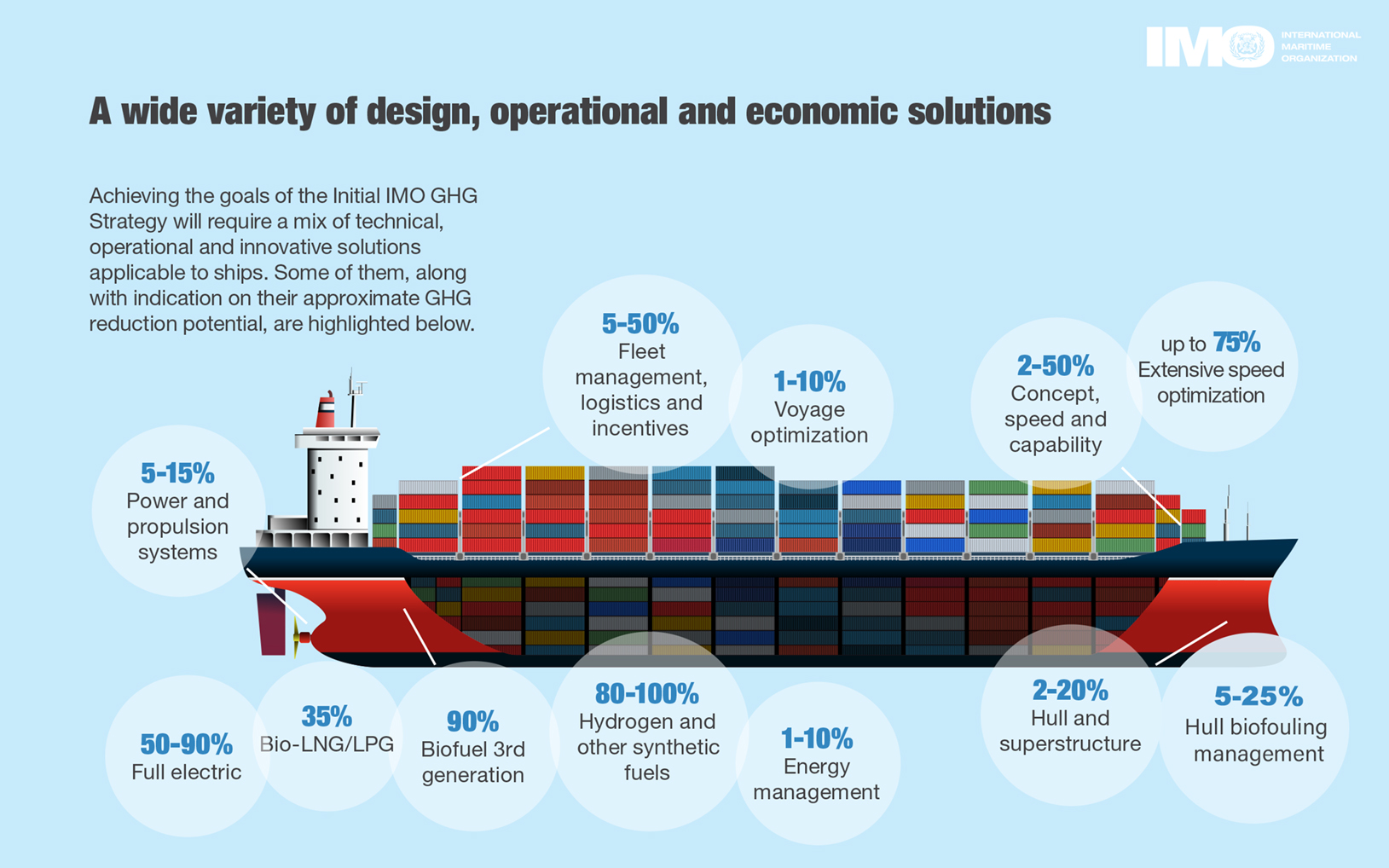 Decarbonation paths as proposed by the IMO
| Technology | Category | Potential |
|---|---|---|
| Sail ships | Propulsion | Considerable |
| New fuel : Hydrogen | Fuel | Considerable |
| Batteries | Propulsion | Considerable |
| Nuclear energy | Propulsion | Considerable |
| New fuel : ammoniac | Fuel | Excellent |
| New fuel : methanol | Fuel | Excellent |
| Green methane | Fuel | Excellent |
| Foils | Propulsion | Excellent |
| Carbon Capture | Other | Very important |
| Carbon capture - quicklime | Other | Very important |
| Rigid sails | Propulsion | Important |
| Gigantism | Other | Important |
| Shore power | Technique | Important |
| Blue fuels | ND | Important |
| Hybrid propulsion | Propulsion | Important |
| Shore power via barge | Technique | Important |
| Biofuel | Fuel | Active |
| Kyte | Propulsion | Active |
| Slow steaming | Logistics | Active |
| LNG fuel | Fuel | Active |
| Photovoltaic cells | Propulsion | Active |
| Fins | Propulsion | Active |
| Shaft power reduction | Technique | Active |
| Antifouling paint | Technique | Moderate |
| Cylindrical Rigid Sail Vessel | Propulsion | Moderate |
| Route optimizations | Logistics | Moderate |
| Logistics | Logistics | Moderate |
| Ship optimization | Technique | Moderate |
| Air Lubrication | Technique | Moderate |
| Rudder and propeller | Technique | Moderate |
| Waterjet | Propulsion | Moderate |
| Hull cleaning | Technique | Moderate |
| Shaft generator | Propulsion | Moderate |
| Trim | Optimization | Moderate |
| Heat recovery | Technique | Moderate |
| Real time consumption | Optimization | Moderate |
| Aerodynamics | Technique | Light |
| Propeller | Technique | Light |
| Power reduction | Technique | Light |
| Propeller cap | Technique | Light |
| Pre swirl stator | Technique | Light |
| Gate rudder | Technique | Light |
| Nozzle | Technique | Light |
| Propulsion control | Technique | Light |
| Just in time | Logistics | Light |
| Ballast management | Optimization | Light |
| Energy management | Optimization | Light |
| Proactive maintenance | ND | Light |
| Boiler control | Technique | Light |
| Incinerators | Technique | Light |
| Bunker management | Technique | Light |
| Autopilot | Technique | Light |
| Scrubbers | ND | NA |
| Maintenance | Other | NA |
| Crew training | Other | NA |
The table above provides a summary of GHG reduction measures for the marine industry. This table is constantly being enriched and does not claim to be exhaustive. You can propose a measure that you consider worthy of interest and send it to us via the form in contact. Any companies mentioned are for information purposes only and do not in any way constitute an advertisement for these companies or a recommendation on our part. We leave the reader alone to judge the relevance of the listing.
Potential corresponds to the potential for GHG avoidance by applying the measure in relation to the current situation on a strictly technical level. Therefore, no account is taken of economic or financial feasibility or life cycle analysis.
The criteria used to judge the potential of a measure are based on the estimated reduction in GHG emissions :

Eolyss / copyright 2019 - 2025
Eolyss Solutions inc - Canada / Quebec 1175195081
136, avenue Vivian Montreal H3P 1N7 Qc Canada